Discovering Your True Talent: The Three Key Clues

Work feels fulfilling when you operate in the area of your gifting. When someone works within their talent, the effort looks seamless, the performance sharp, and the experience enjoyable to watch.

You have likely seen it. A gifted leader in motion. A musician at their best. An athlete performing with precision. A teacher, or even an author, doing exactly what they were made to do. Such moments command attention because excellence has a certain clarity.

People who operate in their strengths often earn more. Their work speaks for itself. Quality becomes their signature.

Talent, of course, can be overrated. Talent alone will not carry you far. Effort is required. Discipline matters. Perseverance is non-negotiable.

Yet the opposite is also true. Hard work cannot fully compensate for the absence of natural aptitude. Skills can be learned. Knowledge can be acquired. But without inherent talent, progress in a chosen field eventually meets a ceiling.

When talent, skill, and knowledge converge, however, the results are remarkable.

So, how do you identify your true talent?

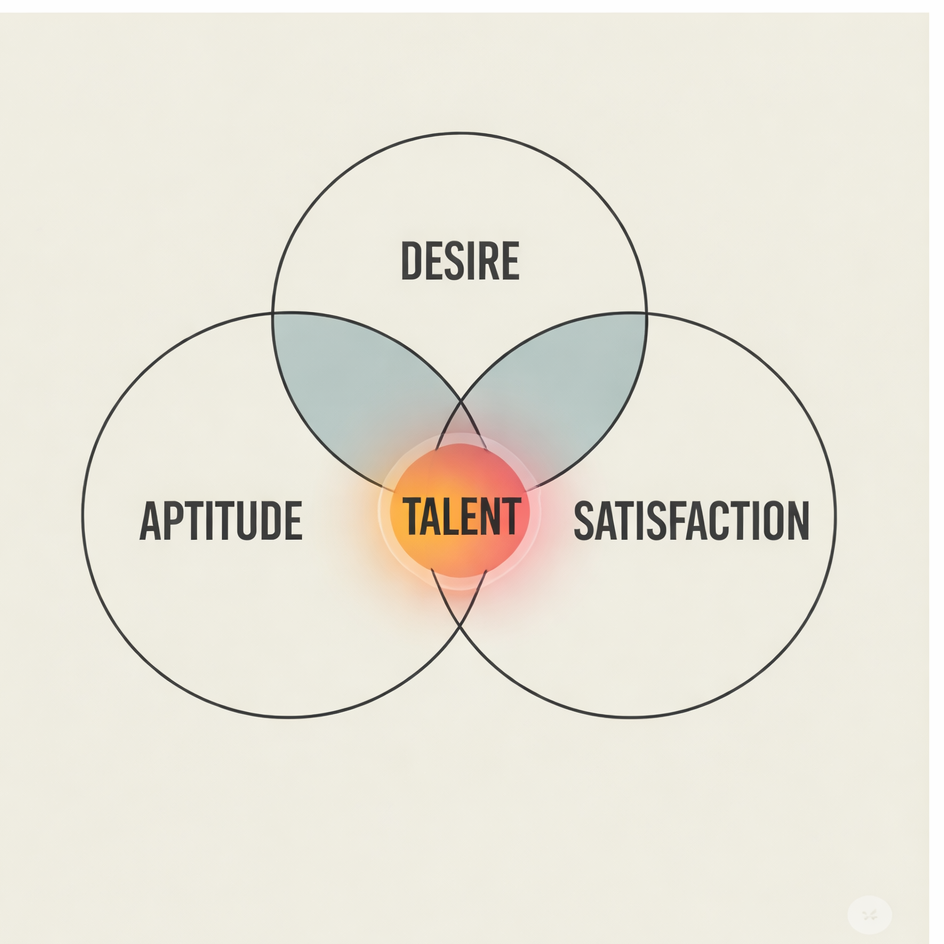
A helpful framework points to three clues that leave a clear trail: yearningsrapid learning, and satisfaction. When these appear together, they often signal a gift placed within you.

1. Yearnings (Desire)

Your deep desires reveal the presence of an inert — or God-given — gift. This is especially true when those desires appear early in life.

Social pressure, financial hardship, or lack of opportunity can bury these longings. Yet they rarely disappear.

If you want to discover your talent, pay attention to what you have always wanted to do.

What have you longed for all your life?

Perhaps you remember being chosen to lead. Perhaps you felt a strong pull toward public speaking. Perhaps you dreamed of building businesses, creating wealth, and caring well for your family or even contributing to your nation’s wellbeing.

Such desires are not random. They often point toward your design.

2. Rapid Learning (Aptitude)

Another trace of talent appears when you begin learning a skill and your mind seems to light up. Concepts connect quickly. Patterns make sense. You grasp ideas faster than others.

This ease does not mean effort is unnecessary. It means you possess a natural wiring for that activity.

Aptitude is a signal. Pay attention to where learning feels unusually natural.

3. Satisfaction (Joy in Doing)

The final clue is deep satisfaction.

It feels good to do the work. There may be fear, nerves, or challenges, yet there is genuine pleasure in the doing. Like a musician performing, an actor in character, or a singer delivering a song, you sense that this is what you were made for.

Often, others feel it too. People are helped, moved, or inspired by what you do.

Where Talent Lives

Your talent sits at the intersection of three circles:

  • Desire — what you long to do
  • Aptitude — what you learn quickly
  • Satisfaction — what brings deep joy

Where these meet, you are likely standing in the center of your calling.

Pay attention. Your life has been leaving clues.

Embrace Long-Term Thinking for Lasting Fruitfulness


Note: This post has been revised and re-shared to give updated information and insights.


The illustration was flawed, but it made the point. A man posed an intriguing question while sitting at a conference in Nyanga, Zimbabwe. This is a beautiful region bordering Mozambique.

He asked, “If you had only one apple and were hungry, would you eat it or plant it? By eating it, you satisfy immediate hunger, but the next generation face starvation. By planting it, you guarantee future abundance, even at the cost of current hunger.”

The flaw in this illustration is that you first need to eat the apple to get seeds to plant. In this case, consumption drives production. Nevertheless, the essence of the question remains: Are you willing to forgo short-term gratification for long-term rewards? 

We live in a world where short-term thinking is the norm. Many people don’t plan beyond today. Some plan for a week, a month at best. But few think in terms of a year, let alone three, five, seven, fifteen, or even twenty-five years ahead. In contrast, some societies plan decades in advance — sometimes as far as fifty years.

This mindset is understandable. For those living hand-to-mouth, immediate survival takes priority. There is no time to worry about tomorrow — tomorrow will take care of itself. As the Bible says in Matthew 6:34, “Sufficient for the day is its own trouble.”

Nonetheless, the truth is that anything worthwhile takes time. Patience can be hard. But it’s indispensable to lasting fruitfulness. Worthwhile pursuits need planning. Execution. Willingness to fail, learn, and try again. As the saying goes, 

“We overestimate what we can achieve in one year. But we underestimate what we can achieve in five.”

Things that take longer to grow and mature are more sustainable and have a greater impact. This applies to life in general, spiritual growth, wealth creation, career growth, businesses, and other pursuits.

Similarly, it typically takes five to seven years for a product or business to scale. Real profitability in any venture often materializes after a sustained five-to-ten-year execution plan. But to achieve this, one must think and plan long-term.

The biblical story of God creating a nation from one man — Abraham — illustrates this point. It took over four hundred and fifty years for this to come to fruition. Yet, God was willing to wait and work within the natural processes of life.

More than anything, this demonstrates God’s patience and perseverance. We do not live that long. We also lack God’s omnipotence. So, we must temper our ambitions. We should approach them with a multi-generational perspective instead.

The key encouragement here is that we can achieve what we set our minds to — but not instantly.

It requires patience, persistence, and methodical progress. We need to take small deliberate steps consistently. Our efforts will compound over time. This will lead to exponential results. The journey may start slow, but the long-term advantages will be undeniable.

How to Become a Long-Term Thinker

1. Make Time to Think and Plan

We live in a world where busyness is often mistaken for productivity. Many people are occupied with non-essential activities that do not contribute to meaningful progress.

To break this cycle, we must de-cluster our lives and dedicate time to thinking and planning. Set aside moments daily. Think about where you want your life, family, career, business, and finances to be in the next five years. Consider the next ten years as well.

2. Set Clear Goals

Once you have taken time to think, define your goals.

What are five key things you want to achieve in the next twenty-five years, God willing? Break these into quarterly milestones, giving you 100 quarters to achieve them.

With such a long time-frame, failure to achieve your objectives is unlikely if you stay committed.

Even if you focused on achieving just one major goal in that period, what would it be? Start working on it now and track your progress every three months.

Long-term thinking is a powerful advantage. By embracing it, we position ourselves for sustained progress and a legacy that outlives us.

Why Preparation Leads to Success in Life Decisions

Many people start things. Few finish them.

Many start construction projects. Few finish them. Many join gym memberships in January. Few stay consistent through the year.

Some leave employment to pursue entrepreneurship. A few years later, they are back in employment. Others, nevertheless, thrive.

Many start studies—a master’s degree, a PhD, a professional course. Again, only a few finish.

What explains the difference between those who start and finish, and those who start but never finish what they began?

The Problem with “Just Start”

I suspect the answer is simple: many do not count the cost.

We live in a culture that celebrates the mantra, “Just start!” But should you? What would the Lord Jesus say about that?

In Luke 14:28–30, Jesus says:

“For which of you, desiring to build a tower, does not first sit down and count the cost, whether he has enough to complete it? Otherwise, when he has laid a foundation and is not able to finish, all who see it begin to mock him, saying, ‘This man began to build and was not able to finish’” (emphasis added).

This is very different from the modern slogan: Just do it. You want to build a tower? Just do it. You want to go to war? Just go for it.

That is not Jesus’ counsel.

Be Prudent Before Taking Action

Jesus continues in Luke 14:31–32:

“Or what king, going out to encounter another king in war, will not sit down first and deliberate whether he is able with ten thousand to meet him who comes against him with twenty thousand? And if not, while the other is yet a great way off, he sends a delegation and asks for terms of peace.”

Failure to count the cost often leads to failure. Failure to ask whether we have what it takes to finish what we start leads to disappointment and shame.

At its core, this is about prudence and preparation.

We often celebrate the few who “jumped” and things worked out. But they are rare. Many jumped and did not land well. Many quit stable jobs to “do their own thing” and eventually had to return to employment.

Wisdom Begins with Discernment

Here is the point: we must be prudent about what we plan to start.

Proverbs 14:8 says: “The wisdom of the prudent is to discern his way, but the folly of fools is deceiving.”

Discernment comes first. Where do you want to go? What will it take to get there?

To discern simply means to find out or perceive. This requires research. It requires asking hard questions. Seeking godly counsel from the older and wiser.

You want to pursue a certain career path? Good.
What will it take to finish it?
Do you have the aptitude for its core demands?

You want to be a lawyer? Do you have the capacity to read long cases? To write and argue persuasively? To deal with difficult clients—sometimes criminals seeking loopholes in the justice system?

Count the cost.

Beware of the Danger of Recklessness

Proverbs 14:15–16 adds:

“The simple believes everything, but the prudent gives thought to his steps. One who is wise is cautious and turns away from evil, but a fool is reckless and careless.”

The unwise person believes everything he hears.

Someone says, “I quit my job and started my own business. I’m doing very well.”
No questions are asked. Is it legal? Is it ethical? Is it sustainable?

The simple believes everything.

But the prudent gives thought to his steps. He practices delayed decision-making, especially in major life choices. He asks: What will this cost me? Do I have the knowledge and capacity required? What preparation is necessary?

Preparation Makes Completion Possible

Consider a man who wanted to run his own business. He struggled to work for others, but he had responsibilities—a family to support and school fees to pay.

Instead of “just jumping,” he prepared. He saved two years’ worth of living expenses. Only then did he resign and start a small manufacturing and contracting business. That financial cushion gave him time to learn the business. By the third year, he earned enough to sustain his family.

Another wanted to build a home. Instead of starting construction right away, they first secured land. For years, they met only the basic development requirements. During that time, they saved. They bought building blocks and stored them. They saved for the roof, then for the interior finishes.

When construction finally began, the house was completed in less than six months.

Painstaking preparation. Swift execution. Successful completion.

It Is Wise to Wait

It is okay to wait.
It is wise to prepare.
It is godly to count the cost.

Preparation matters.

So before you start anything, ask yourself this question:

Do you have what it takes to finish what you are about to start?

Three Wellness Essentials for Fruitfulness in the Year Ahead

The year was 2024—January, to be precise. I began to feel pain on the left side of my chest. I lecture in Pathology, which is the study of diseases. Instantly, my mind went to the worst-case scenario. This could be a serious heart problem.

I went to the hospital, where they ran all the necessary cardiac tests and imaging. Everything came back normal. The consulting doctor completed his due diligence. He then asked me a simple but piercing question:
“How much do you sleep?”

He had me there.

I had been “pushing” hard the previous year. Five-hour nights were the norm. I was in serious sleep debt. Stress had accumulated. Prolonged work without adequate rest began to manifest as muscle pains.

That experience taught me an important lesson: we must be good stewards of our bodies. Ancient Stoic thought viewed the body as something evil. It was to be punished, starved, and deprived. But, the body is meant to be carefully stewarded. We are body and soul. Our spirits dwell in our bodies. If we destroy our bodies with unhealthy habits, we neglect our duty as stewards. Scripture calls the body the temple of the Holy Spirit.

How were temples kept? Clean, orderly, welcoming, and well maintained. Likewise, wise stewardship of our bodies is essential for optimal performance and productivity this year. It is part of faithfulness—and faithfulness leads to fruitfulness in both work and life.

There is very little we can truly enjoy without good health. So how can we be better stewards of our bodies this year? I would like to suggest three cardinal principles.

Eat Rightly

What we eat accounts for about 80% of the battle for good health. Even weight loss is largely about eating—roughly 80% diet and 20% physical activity.

It is not only what we eat, but also how we eat. Quantity matters. How much we eat will eventually show. We reap what we sow, even in matters of diet.

Extremes must be avoided. Both under-eating and over-eating lead to poor health. One results in malnutrition; the other in obesity. Both carry serious health consequences.

Concerning food choices, excessive fat, salt, and sugar should be avoided. In Scripture, fat was always offered to the LORD. It was burned as a pleasing aroma. The priests or the people did not eat it (Leviticus 7:23). Sadly, the sons of Eli were worthless men. They sinned by demanding meat with the fat still on it (1 Samuel 2:12–17). It may not be accidental that their father, Eli, is later described as “heavy.” Excess fat has a way of showing up.

Is the Lord not wise in instituting this law? He knows that excess fat (lipids) is harmful. Too much fat leads to weight gain, which results in fat accumulation in blood vessels. These vessels become narrowed, forcing the heart to pump harder to circulate blood. This increased pressure leads to high blood pressure and its related complications. A T-bone steak may be enjoyable—but moderation is essential.

Similarly, excessive salt intake contributes to high blood pressure, while sugary foods predispose one to diabetes—the so-called “sugar disease.”

I am not one to prescribe whether one should eat only white meat or avoid certain foods altogether. God said, “Every moving thing that lives shall be food for you” (Genesis 9:3). Scripture also warns against forbidding foods that God created to be received with thanksgiving by those who believe and know the truth (1 Timothy 4:1–5).

What is consistently recommended is moderation in all things (Philippians 4:5).

One final point on eating concerns frequency. How many times should we eat per day? There is no strict rule, and we must be careful not to impose one. However, Scripture reveals a pattern of God providing food twice daily—morning and evening. This was the case with manna (Exodus 16:8). Elijah experienced the same situation. Ravens fed him bread and meat in the morning and evening (1 Kings 17:6).

I have noticed a similar pattern in rural communities. People often eat twice a day. They supplement with natural snacks during the day.

Scientifically, this pattern also has merit. It allows the body enough time to break down food and extract nutrients needed for daily energy.

Ultimately, we become what we eat. Let us resolve to pursue healthy eating with moderate portions. This will greatly enhance our productivity and effectiveness in all our endeavors.

Exercise Regularly

Bodily training is indeed of some value (1 Timothy 4:7). Regular exercise—especially cardiovascular activity—stimulates blood flow, burns excess fat, and promotes overall health.

Many studies show a strong correlation between physical inactivity and non-communicable diseases such as hypertension. Increased physical activity often helps stabilize blood pressure.

Exercise does not need to be intense. Consistency beats intensity. Four to five sessions a week are enough. Nor does one need a gym. Walking alone—aiming for about 10,000 steps a day—is effective, accessible, and free. The streets cost nothing to walk on.

If you can jog, that is excellent. While excessive jogging may lead to knee problems over time, done in moderation it is a beneficial form of exercise.

Whatever form it takes, let us commit to some form of bodily exercise.

One final observation: exercise is strongly correlated with success in life. Exercise requires being intentional. One does not accidentally become consistent at it. You plan, get up, dress up, and get going. Scott Adams, in How to Fail at Almost Everything and Still Win Big, writes:
“I believe exercise makes people smarter. It makes them psychologically braver. They become more creative, more energetic, and more influential.”

I agree. The same discipline that drives a person to succeed is often what sustains an exercise routine.

If you do not exercise, start small. Even ten minutes of walking a day can make a meaningful difference.

Enough Rest

This is where I personally failed—and have since repented. I now aim for six to seven hours of sleep each night, which I have found to be enough.

The day is neatly divided into three eight-hour segments. Eight hours are for sleep. Eight hours are for work. Eight hours are reserved for everything else. Traditionally, Sunday—or Saturday for some—serves as a day of rest.

We need this rhythm. We need to work. We also need adequate rest. Rest restores the body and re-balances its chemistry. A good night’s sleep is essential for proper functioning.

Prolonged sleep deprivation is detrimental to both physical and mental health. Its effects can resemble alcohol intoxication—dizziness, impaired judgment, and reduced coordination.

It is telling that when the prophet Elijah fell into despair, part of God’s remedy was simple. “He lay down and slept under a broom tree” (1 Kings 19:6–7).

Again, moderation applies. A lazy person clings to the bed, as a door turns on its hinges (Proverbs 26:14). Oversleeping reflects sloth. But enough sleep is a blessing.

Napping can also be beneficial when circumstances allow. Take advantage of it when you can.

All the best for the year ahead.

Seven Life Lessons for Personal Growth

For the past eleven years, I have made it a habit to write reflections on my birthday. Sometimes they take the form of prayers. Other times they are lessons learned along the way. Today is no different. These are some of the lessons that growing older has impressed upon me. As you read, see whether they resonate with your own experience.

Age has a way of maturing us. Time tempers ambition. It forces us to be realistic. Successes and failures become teachers no classroom can match. We learn what we are capable of. And just as importantly, what we are not.

By midlife and beyond, one gains practical wisdom. You start to see through appearances. You separate substance from noise. You even discern character more clearly. You learn to distinguish what is genuinely formative from what is merely motivational nonsense.

Many of these lessons can be grouped under a few themes. Conveniently, they all start with the letter P.

  1. Providence Matters

Providence is the preservation, superintendence, and purposeful direction of all things by God. It is the divine governance by which events—ordinary and extraordinary—are woven together to achieve God’s purposes.

None of us chose where or when we were born, nor the families into which we arrived. Scripture reminds us that God “determined allotted periods and the boundaries of their dwelling place” (Acts 17:26). Our times, seasons, and environments shape us far more than we often acknowledge.

Warren Buffet has famously attributed much of his success to being born in the right country. He was born to the right parents. It was also at the right time. That is providence. Our paths, too, are providential. Like Esther, we may well have come to our place “for such a time as this.”

I was born in Zambia at a particular time, with certain abilities and privileges others did not have. You, too, have your own distinct circumstances and advantages. Purpose is often discovered when we rightly understand our times and make faithful use of them.

This reality should cultivate humility, not passivity. Providence is never an excuse for inaction. Instead, it urges us to steward our circumstances wisely. We should seek the Lord as He opens and closes doors. He leads us through different seasons of life.

  1. Precepts Matters

Yet as important as providence is, the precepts of God matter more. “The secret things belong to the LORD… but the things that are revealed belong to us” (Deut. 29:29).

Our responsibility is not to interpret circumstances like omens, but to obey what God has clearly revealed. We are commanded to sow, to work diligently, to act faithfully—and to leave the outcomes with God.

Not every open door should be walked through. An opportunity that violates moral convictions is not validated simply because it appears providential. God’s Word, not circumstance, is our primary guide.

We anchor our lives in the precepts of Scripture. We act with courage and diligence, pursue our calling faithfully, and trust God with the results.

  1. Proactivity Matters

Maturity allows us to hold complementary truths together. God is sovereign—and we are responsible.

In light of both providence and precept, we are called to be proactive. Proactivity means acting with foresight rather than merely reacting. It means making decisions shaped by values, not impulses.

Joseph understood this well. He could not control the coming famine, but he prepared for it. He saved during the years of plenty so that many would live during the years of scarcity. Providence revealed the future; proactivity shaped the response.

So move forward. Decide. Act.

  1. Patience Matters

One lesson time teaches relentlessly is that progress cannot be rushed. We cannot cheat time.

Every generation is tempted by the promise of rapid gain. Scripture consistently warns against this impulse. “The plans of the diligent lead surely to abundance, but everyone who is hasty comes only to poverty” (Prov. 21:5).

Patience is not inactivity. It is steady, disciplined effort over time. Progress is usually incremental—little by little. I struggle with this truth myself, but it remains true nonetheless.

  1. Processes Matters

Goals are important, but systems are decisive. Goals achieve milestones; processes sustain progress.

Healthy systems make achievement repeatable. Just as the body functions through interconnected systems, our lives require rhythms and structures.

Spiritual growth requires regular habits of prayer, Scripture, fellowship, and teaching. Strong marriages require intentional communication and shared time. Financial stability requires earning, restraint, saving, investing, and generosity.

Build systems that quietly but consistently move you toward the outcomes you desire.

  1. Perspective Matters

A hopeful perspective carries people further than perpetual negativity. Those with a grounded outlook see opportunity where others see obstacles, trusting that God works all things together for good.

  1. Perseverance Matters

Perseverance, then, is simply refusing to grow weary in doing good. Keep going. Walk if you can. Crawl if you must. But do not stop.

Conclusion

These are some of the lessons I have learned so far. I hope they prompt reflection.

What are the things you have come to know that truly matter in this life? I would be interested to hear your list.

Please also subscribe to receive these posts in your emails straight. Thank you!

How to Live a Well-Ordered Life this Year

A pastor once shared a sobering lesson from the early days of his ministry and family life. While planting a “startup” church that demanded energy, focus, and sacrifice, he neglected his family. Yes, the ministry thrived—but family life quietly suffered.

The turning point came when his wife asked him to pause and think carefully about his responsibilities—not only as a pastor, but as a husband and father. She reminded him of a weighty truth: one day, he would give an account to the Lord for how he led his family. That conversation changed everything.

Placing responsibilities in their proper order produces a well-managed, well-ordered life. It clarifies what matters most. It exposes the truth that not everything is equally important. Order brings focus. Focus brings fruitfulness.

A well-managed life is orderly. There is routine. There is predictability. The person who lives such a life is well-ordered—usually calm, rarely frantic. There is no constant frenzy. Such a person does not attempt to do too many things. They are humble enough to know what they can and cannot do.

A disorderly life, on the other hand, is full of emergencies. There are too many commitments. Most of which are not important. Too many meetings and events that add no real growth. A chronic inability to say no. Much multitasking, yet little meaningful progress on any front. Deadlines are constantly missed. Work is sloppy. Relationships at home are strained. Priorities are unclear or inverted.

Here are two suggestions to order our lives well, and be good stewards of the lives we live.

  1. Identify Your Core Responsibilities

One practical step toward a well-managed life is conducting a personal audit of responsibilities. This guards against being caught off guard. It helps prevent negligence and imbalance.

Our pastor friend did exactly this. He began to pray intentionally, asking God to reorder his life according to divine priorities. Clarity followed. He wrote down four defining statements that brought structure and conviction to his calling: 1) I am a person with a responsibility before God. 2) I am a partner with a responsibility to my wife. 3) I am a parent with a responsibility to my children. 4) I am a pastor with a responsibility to my congregation.

What about you? What are your core responsibilities? Are they correctly—and biblically—ordered?

If the ordering of relationships and responsibilities laid out by Paul in Ephesians 5 and 6 is anything to go by, then there is a right order.

First, believers are called to walk as children of God (Ephesians 5:1–20). This means walking as Christ walked—walking in love, purity, light, wisdom, and in the Spirit.

If one is married, the marital relationship follows next and takes precedence over others. Husbands and wives are given clear instructions on how they are to relate. The husband’s primary responsibility is to love his wife by cherishing and nourishing her. The wife’s primary responsibility is to submit to and respect her husband (Ephesians 5:22–33). Simple, yet profound.

Only after this relationship is addressed are children mentioned. The order matters. Placing children above the husband–wife relationship breeds an ill-ordered life—unless, of course, that marital relationship does not exist. Parent–child responsibilities take precedence over work relationships. One cannot sacrifice marriage or parenting on the altar of career advancement and economic progress.

The final relationship addressed is that of work—the master–slave, or employer–employee, relationship. Even here, work is to be done “as to the Lord and not to man” (Ephesians 6:7).

  1. Commit to Faithfulness in Your Core Responsibilities

Faithfulness means being loyal and steadfast to these core responsibilities—and to their God-given order.

It means being reliable in doing what one ought to do in each relationship. Faithfulness is not passive; it calls for deliberate action.

It requires saying “no” to things that divert attention from commitments to God, spouse, children, and work—in that order.

Faithfulness is fidelity. Fidelity to God. Fidelity to spouse. Fidelity to children. Fidelity to work. It means keeping one’s word.

Overcommitting in peripheral areas erodes faithfulness in core responsibilities. Learning to say “no” is not only wise—it is necessary for fruitfulness. It keeps life well-ordered and well-managed.

Conclusion: Faithful and Fruitful

A well-ordered life is a calm and quiet life. We are counselled in the Scriptures to: “aspire to live quietly, and to mind your own affairs, and to work with your hands, as we instructed you, so that you may walk properly before outsiders and be dependent on no one” (1 Thessalonians 4:11-12).

Walking properly means our lives are to be devoid of marital dramas, infidelity at work, or neglected children or relationships. Time must be well spent and accounted for.

Our God is a God of order. We must follow suit.

A well-ordered life does not happen by accident. It is cultivated through clarity of responsibility and disciplined focus. When responsibilities are rightly ordered, time and energy are invested wisely.

The central aim is simple, though demanding: strive to live a well-ordered and well-managed life this year.

May grace be given to you and me to live such a life.

Three Key Principles for Progress in 2026

2026 is upon us. Time waits for no one.

I don’t know how last year was for you. Mine was filled with both joys and sorrows—achievements and failures, progress and stagnation. I felt lost, but also found. I had quite a few visits from the “noonday devil”: that season of wondering whether I was in the right career, whether I was doing what I should be doing.

You have your own stories too. For some, it was the best year. For others, it was a nightmare year. For many, it was both.

But a new year is upon us, and we must press on. We must move forward. We cannot stay in the past. We owe it to ourselves, our families, our friends, and to the Lord to move forward.

In my love of reading, I picked up a book by Dr. David Jeremiah. He recently wrote a book titled Forward: Discovering God’s Presence and Purpose in Your Tomorrow. He is an expository preacher. I used to listen to his program, Turning Point, on Christian television, and it was a blessing to me. No wonder I was excited to see that he had written a book encouraging people to move forward.

The premise of the book is simple but powerful: encouraging believers to move forward. I would like to echo that same message—move forward in 2026 toward the upward call of God in Christ Jesus.

But in order to move forward, we need to follow the instructions of the great Apostle Paul in Philippians 3:12–15.

Few people accomplished as much for the Lord Jesus as Paul did. He had a clear calling, vision, dream, and goal. His ambition was to preach Christ where He had not yet been named1. He won much of the known world for Christ—from the Middle East into Europe—and eventually died in Rome, Italy. In these verses, we learn something of the secrets behind such progress and success.

From his writing in the text, we can extract three vital principles for progress.

1. Acknowledge That You Have Not Yet Arrived

First, we must acknowledge that we have not yet achieved all we have set out to do. Paul says: ‘Not that I have already obtained this… I do not consider that I have made it my own’ (Philippians 3:12-13).

Put more positively, there is still more to achieve. There is still something to be accomplished: a goal to be met, a project to be completed, a person to be spoken to, a soul to be won for the Lord, a financial milestone to be reached.

We have not obtained or achieved all that the Lord has called us to do. We are not done until we are done—and for us, that means finishing our course on earth and going to be with the Lord. So while we are still here, we keep moving forward.

2. Forget What Lies Behind

The second principle is this: to move forward, we must forget what lies behind.

Whatever is in the previous year, we must forget. Not in the sense that we cannot learn lessons from it, but in the sense of not dwelling too much on past successes or failures. In other words, do not let your past control you. Be inspired by the future. Be drawn by what can be, rather than by what has already happened.

Sometimes, our past successes can be the greatest obstacle to moving forward to greater achievements. Jim Collins and Bill Lazier warn of what they call the “We’ve Arrived Syndrome.” In their book Beyond Entrepreneurship 2.0, they tell the story of a company called Strategic Software, Inc. For the first seven years, employees and managers worked twelve-hour days in tiny cubicles. Gradually, the company achieved financial success—millions in revenue. Then they moved into a prestigious office complex with modern sculptures and beautiful surroundings. Soon after, the company fell apart. One founder said, “We looked around and found that success had brought malaise. We just didn’t have that same fighting spirit. From there, it was all downhill.”

Beware of the same danger.

I felt something similar after my wife and I reached a particular goal we had set for ourselves. The malaise set in for me. The goal had been reached. What next?

Forget what lies behind. Be inspired by it. Learn from it. But stop reliving it. Move forward.

We are also to forget failures and sorrows. You can never truly move past the loss of a loved one—but you can still move forward. You may have lost your income or your job—but you can still stand and move forward. People may have treated you badly. You may have failed an exam, a program, or a venture. You may even have experienced moral failure. Forget it—not by denying it, but by learning from it. Repent, if need be. Get up and move forward. The prize lies ahead. Finishing well is what matters most.

3. Move Forward to What Lies Ahead

The third principle is to strain forward to what lies ahead. The language Paul uses is strong: straining, reaching, pressing on. Sometimes moving forward requires effort. It may require summoning strength and energy. Moving forward requires intention. You must decide to move. You must exert yourself and keep going.

Dr. Jeremiah, in the book mentioned above, encourages readers to move forward by dreaming, praying, choosing, focusing, risking, pursuing, believing, investing, finishing, and finally celebrating. I have also made my own list, drawn from Paul’s words and from other biblical characters and passages.

  • Move forward with a dream or vision

Have a clear picture of what you believe God wants you to do. Envision a bigger, better, and brighter future.

That is what the heroes of faith did in Hebrews 11:16—they desired a better country, a heavenly one. That desire moved them forward in faith to do what God had called them to do.

Even while we are still here on earth, we must envision and desire something better: a better place to live, a better marriage, better relationships with our children, a better church and service within it, a better company, better financial stewardship, better clients, a better life.

Move forward with a new dream—a new vision of where you want to be by the end of the year.

  • Move forward with a goal

Paul says in our foundational text that he was pressing on toward the goal. He had something specific in mind. A goal is a vision that is specific, time-bound, and measurable. Paul desired to preach the gospel in Rome—and to Rome he went. He wanted to know Christ and the power of His resurrection and to share in His sufferings—and that he did.

What is your goal? Is it specific? “To love my wife better” is not specific enough. “To love my wife by having date nights twice a month and listening to her without distractions” is a good goal. That is twenty-six dates in a year, and you can measure it. “To earn more money this year” is vague. “To earn or save a specific amount every month” is measurable. You will know whether you have achieved it or not. I hope you have a goal you are pressing toward this year.

  • Move forward in prayer

How else can we move forward unless we hear from our Heavenly Father—who leads, guides, directs our paths, and helps us reach the prize of the upward call in Christ Jesus?

We must move forward in much prayer this year. We must be like David, who inquired of the Lord frequently. He did not make a move without seeking God’s direction. Should he attack the enemy? He inquired of the Lord. Should he flee from his pursuer? He inquired of the Lord.

Should you take a new job—or even apply for it? Inquire of the Lord. Should you immigrate to another country? Inquire of the Lord.

Move forward by spending much time in secret with your Heavenly Father through Jesus Christ.

  • Move forward with the Word of God

Like Joshua, who faced the daunting task of leading God’s people into the Promised Land, the one thing that would ensure good success and prosperity was meditating on the Law day and night, being careful to do all that was written in it.

Let the Word of God be a lamp to your feet and a light to your path, showing you where to take the next step and which path to walk in.

  • Move forward with focus

Focus on the main thing you should be doing. What is the one thing that, if accomplished, would make everything else easier—or even unnecessary? Identify it. Focus on it. Work on it.

Conclusion

Move forward with courage, with faith, and with determination to finish the year strong, by God’s enabling. Move forward knowing that—if you are a Christian—the Lord is with you.

Therefore, be strong and courageous. In the words of David to his son Solomon: Be strong, and show yourself a man. Move forward with the strength that the Lord provides.

All the best.
Embrace Practical Wisdom for a Purposeful Life

Welcome to Mas’ Insights.

This space exists for one simple reason: to think clearly about everyday life and work through the lens of biblical wisdom. It’s all about skilful living in the present world with an eye to eternity.

Life today is noisy. Advice is abundant. Yet wisdom is scarce. We are told to move faster, earn more, consume endlessly, and measure success by money and staff. Yet many of us sense that something deeper is missing. Clarity. Purpose. Restraint. Direction. And Christ-centeredness.

Mas’ Insights is an attempt to slow things down.

Who Is This For?

This blog is for people who live in the real world. Those who work, trade, farm, build, manage, invest, and lead families. Those who want to honour God without escaping real life. Those who believe faith should shape Monday morning decisions, not just Sunday worship.

It is for anyone asking practical questions like:

  • What does diligence really look like today?
  • How can I have and enjoy more meaningful relationships?
  • How can I honour and glorify God in my work and business?
  • How should a Christian think about money, risk, business, debt, and opportunity?
  • How do you build steadily in seasons of pressure and uncertainty?

The Voice Behind Mas’ Insights

Think of this blog as a sage at the edge of your everyday life—not removed from reality, but shaped by it.

The perspective here is:

  • Biblically anchored – Scripture is the foundation of all (2 Timothy 3:16-17).
  • Practical – Wisdom must influence friendship, stewardship, family, and real responsibilities.
  • Season-aware – Life moves in cycles. What works in one season may fail in another.
  • Steady, not sensational – Progress matters more than hype. Faithfulness compounds.

I write as someone who has spent time in research, business thinking, family enterprise, and faith reflection—testing ideas not only in books, but in lived experience.

What You Can Expect Here

On Mas’ Insights, you will find reflections on:

  • Work, diligence, and vocation
  • Money, wealth-building, and strategy
  • Risk, opportunity, and decision-making
  • Faith lived out in ordinary life
  • Hard-earned lessons from success, mistakes, and seasons of waiting

Some posts will be short and direct. Others more reflective. All aim to be useful, not merely interesting.

A Closing Thought

The book of Proverbs tells us that wisdom cries out in the streets—not only in temples or lecture halls. This blog is my small attempt to listen to that voice and pass it on to those on the streets of life.

If you are seeking clarity over chaosbiblical wisdom over worldly wisdom , and steady progress over shortcuts, then you are in the right place.

Welcome to Mas’ Insights.